
Ever read one of your own social media posts and think, “Who wrote this?” That disconnect is usually the result of an undocumented brand voice. Without clear guidelines, tone drifts from post to post until the brand no longer sounds like itself.
Writing down your brand voice changes that. Once expectations are clear, consistency stops being a guessing game and content stays steady, even as production speeds up. The voice becomes something people can follow instead of interpret.
That reference matters beyond your team. Your AI assistants need it just as much. When both humans and tools work from the same brand voice guidelines, the brand sounds unified rather than scattered across channels.
This is where the process evolves. Not only can AI follow a defined brand voice, but it can also help you create one. With the right inputs, you can generate clear brand voice guidelines your entire team can use with confidence.
What is a brand voice?
Your brand voice is how your brand sounds every time it shows up. It blends personality with tone, plus a consistent writing style that your audience starts to recognize. When that voice isn’t properly documented, messaging drifts fast, especially when AI or outside contributors help create content.
Brand voice guidelines remove guesswork by making your tone choices obvious. They clarify when you should sound playful or professional, direct or conversational.
Why use AI to generate your brand voice?
Using AI marketing tools helps you document a clear brand voice faster than starting from scratch. Instead of guessing tone or manually reviewing old posts, AI can spot patterns, summarize what stands out, and generate a baseline you can refine.
Here’s why AI works so well for brand voice work today:
- It can analyze large volumes of content quickly, which makes pattern spotting easier
- It can surface tone habits you might not notice because you are too close to the brand
- It helps translate vague directions into usable rules your team can follow
- It speeds up documentation so contributors stay aligned
- It gives your future AI-generated content a consistent reference point
AI in marketing is also changing how teams move from simple captions toward more creative output. As AI takes on a bigger role in daily production, a documented brand voice becomes the anchor that keeps everything aligned.
Without it, speed increases while consistency quietly slips. With it, creativity scales without losing the sound your audience expects.
How to generate your brand voice with AI: 3 easy steps
Generating your brand voice with AI doesn’t have to be complicated. Follow this simple three-step framework to get started.
1. Pinpoint what you want your brand to sound like
Before generating anything, decide the personality you want your brand to project. Think of this as the “vibe” behind your posts. Even when using AI content creation tools to refine language or speed up drafts, you still need a clear starting direction.
Here are common tone styles you can choose from:
- Friendly: Warm, conversational, helpful
- Funny: Light humor, clever phrasings, playful
- Bold: Confident statements, strong positions
- Formal: Structured, polished, and clear
- Educational: Instructive, simple explanations, value-first
- Inspirational: Uplifting, encouraging, optimistic
- Direct: Concise, straightforward, no fluff
The examples below show what a clear brand voice looks like once it moves from theory into actual copy.
Duolingo
Duolingo is well known for its chaotic brand energy. Creating nonsensical posts featuring its owl mascot has become the norm for the language learning app.
Here’s a quintessential example of what the brand’s social media content looks like:
When the Duolingo social media team has an idea, the brand runs marathons with it. This has generated tons of awareness around the brand and its content, but this approach also comes with its own risks.
While this level of chaos and humor works well for Duolingo, your brand has to consider how far you’re willing to go with your content. You might opt for a humorous approach…but reel it in a bit from where Duo takes it.
Frank Body
Frank Body is a skincare brand that has also had a recognizable brand voice for years. Frank speaks in the first person, using terms like “me” and “my” when referring to its products.
This fun approach has helped Frank solidify its place in the skincare world, keeping people coming back to its social posts again and again.
Consider how you can create your own unique approach to brand voice. Talking in the first person like this may not make sense for you, but what else can you do to make your brand voice your own?
beehiiv
We also have to include a solid B2B example here. Email marketing brand beehiiv makes B2B marketing approachable with their relatable (and all lowercase) brand voice.
Basically, beehiiv wants to be your B2B bestie. The brand speaks the way two friends would text each other. And that makes the content easy to digest and interact with.
Avoiding capital letters is becoming a popular trend amongst software brands. It certainly makes the captions stand out.
Consider ways you can help your content stand out in feeds—maybe an approach like this is exactly what you need.
2. Generate your brand voice with Vista Social
Vista Social includes a built-in AI brand voice generator inside your workspace settings. Once your brand voice is established, your team can apply it consistently across all AI-generated captions, ideas, and responses.
Here’s how to set up your brand voice:
Step 1: Log in to your Vista Social account
Step 2: Go to Settings
Step 3: Go to Profile Groups
Step 4: Go to Brand Settings
Step 5: Add as much detail as possible about your brand voice so every caption Vista Social generates stays aligned with the tone you have defined.
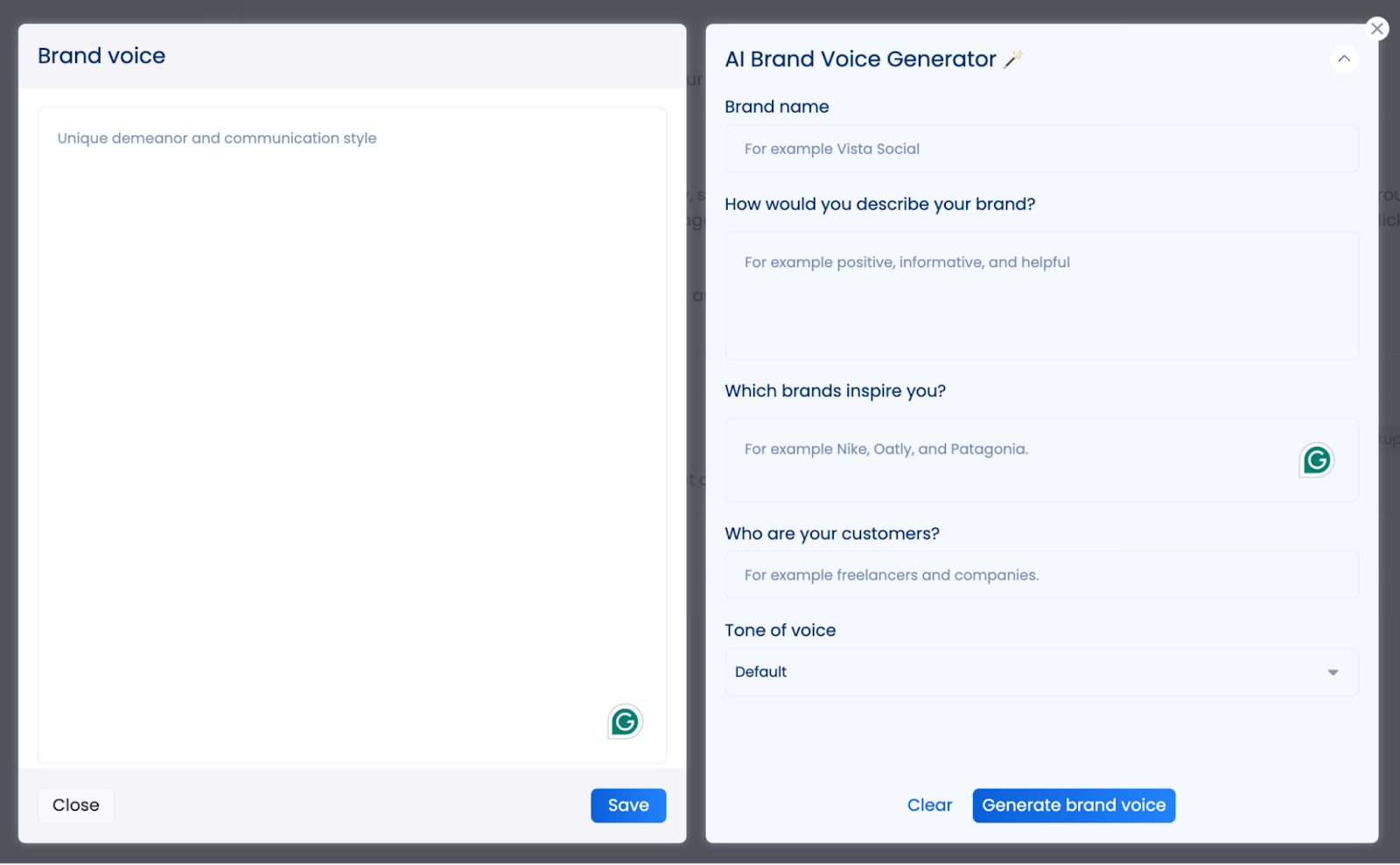
This process keeps your voice consistent as using AI in social media becomes part of your daily content flow. It gives both your team and your tools a clear reference, so nothing drifts as volume increases. That clarity makes it easier to scale content without losing the sound your audience recognizes.
3. Test out your new brand voice and tweak
Once your voice is saved, you can start generating content with Vista Social’s AI assistant.
Here’s how to test and refine:
Step 1: Open the Publisher and create a new post
Step 2: Use the AI assistant to generate a caption or rewrite content using your brand voice
Step 3: Review the output carefully
Step 4: Make edits to refine the personality, phrasing, or energy level
Step 5: If you notice recurring issues, return to your brand voice settings and adjust the tone, rules, or sample sources
Step 6: Repeat the process until you consistently get content that feels “on brand”
It’s completely normal for AI to miss your brand voice at first. After all, you’re training it to match your style through iteration.
When using AI for content creation, small refinements compound quickly, leading to more reliable output. Each round of testing sharpens alignment, making future content easier to produce and more trustworthy.
Do’s and don’ts for using an AI brand voice
Generating your brand voice with AI isn’t a set-it-and-forget-it strategy. You have to create, reiterate, and refine your brand voice so that both your team and your AI assistants can easily match content to your voice and personality.
Do’s
1. Do refine your brand voice over time and treat it as a living document
Your brand voice will evolve as your audience shifts, your offers expand, or your positioning becomes more defined. Updating your AI brand voice regularly helps the tool stay aligned with your current direction instead of outdated assumptions.
2. Do provide clear writing samples to your AI brand voice generator
Your output is only as strong as the inputs you provide. The more accurate, on-brand examples you feed into your AI brand voice system, the easier it becomes for the model to replicate your tone, rhythm, and perspective.
3. Do test your outputs regularly to maintain accuracy
AI learns patterns, but it also needs checkpoints. As you publish new posts, tweak your messaging, or refine your positioning, run weekly tests to ensure the tone still matches your expectations. Small calibration adjustments prevent your brand voice from slowly drifting.
4. Do collaborate with your team so everyone relies on the same guidelines
An AI brand voice is most effective when it is a shared resource. Make sure your team understands how the voice was created, what it represents, and how to use it consistently across platforms.
5. Do explore other tools that support brand consistency and content alignment
AI-powered workflows work best when paired with the right ecosystem of tools, especially as your team scales production. These tools help reinforce your brand voice at every step, from planning to publishing. The result is a workflow that stays aligned without constant manual oversight.
Don’ts
1. Don’t expect AI to match your brand voice on the first try perfectly
Even the strongest model needs several rounds of refinement before it truly matches your tone. Think of the process as onboarding a new writer. Improvement comes from training, examples, and feedback.
2. Don’t rely on AI alone—your final content should always have a human review
Humans catch nuance, context, and emotional accuracy that AI can miss. A quick pass from a content lead or social media manager ensures messaging stays aligned with your brand identity and avoids tone mistakes.
3. Don’t use mismatched, low-quality writing samples
If the samples you provide are inconsistent, outdated, or written by different authors with contrasting styles, the AI will blend them into a confused or diluted voice. Only upload content that represents what you want your brand to sound like today.
4. Don’t ignore inconsistencies; adjust your settings when needed
If the AI begins drifting by becoming too formal, too casual, too repetitive, or too vague, do not simply fix the final output. Update your brand voice settings, refresh your writing samples, or clarify your instructions to prevent the problem from worsening over time.
5. Don’t assume AI can run your social presence without direction
AI can lighten your workload and support execution, but it still needs your strategy and judgment. Without clear direction, output can drift even when the volume looks good. Your role is to set the guardrails so AI works toward your goals instead of guessing its way there.
Generate your brand voice with the help of Vista Social
Your brand voice shapes every interaction, from captions to comments to longer storytelling. When that voice is clearly defined, content stays consistent even as more people contribute. This matters even more now that AI can manage social media accounts at scale.
Vista Social’s AI assistant plus its brand voice generator help you create content that stays aligned by design. You can build a voice profile that reflects your identity. You keep captions consistent across posts. You support growing teams without losing tone. You maintain quality across platforms. You move faster without sacrificing authenticity.
You stay in control. AI works alongside you to keep your brand sounding the way it should every time.
AI brand voice FAQs
Can you train AI to learn your brand voice?
Yes. With the right writing samples, tone preferences, and rules, AI can learn your brand voice and replicate it consistently. Tools like Vista Social let you train your voice profile so all future AI-generated content matches your style.
How can you create a brand voice with AI?
You can create your brand voice by gathering writing samples, identifying tone traits, and using an AI brand voice generator to analyze patterns. This produces a detailed profile you can refine and apply to your future content.
Is it important to have a brand voice?
Absolutely. A clear brand voice ensures consistency, builds trust, strengthens recognition, and helps AI (and your human team) produce content that truly sounds like your brand.