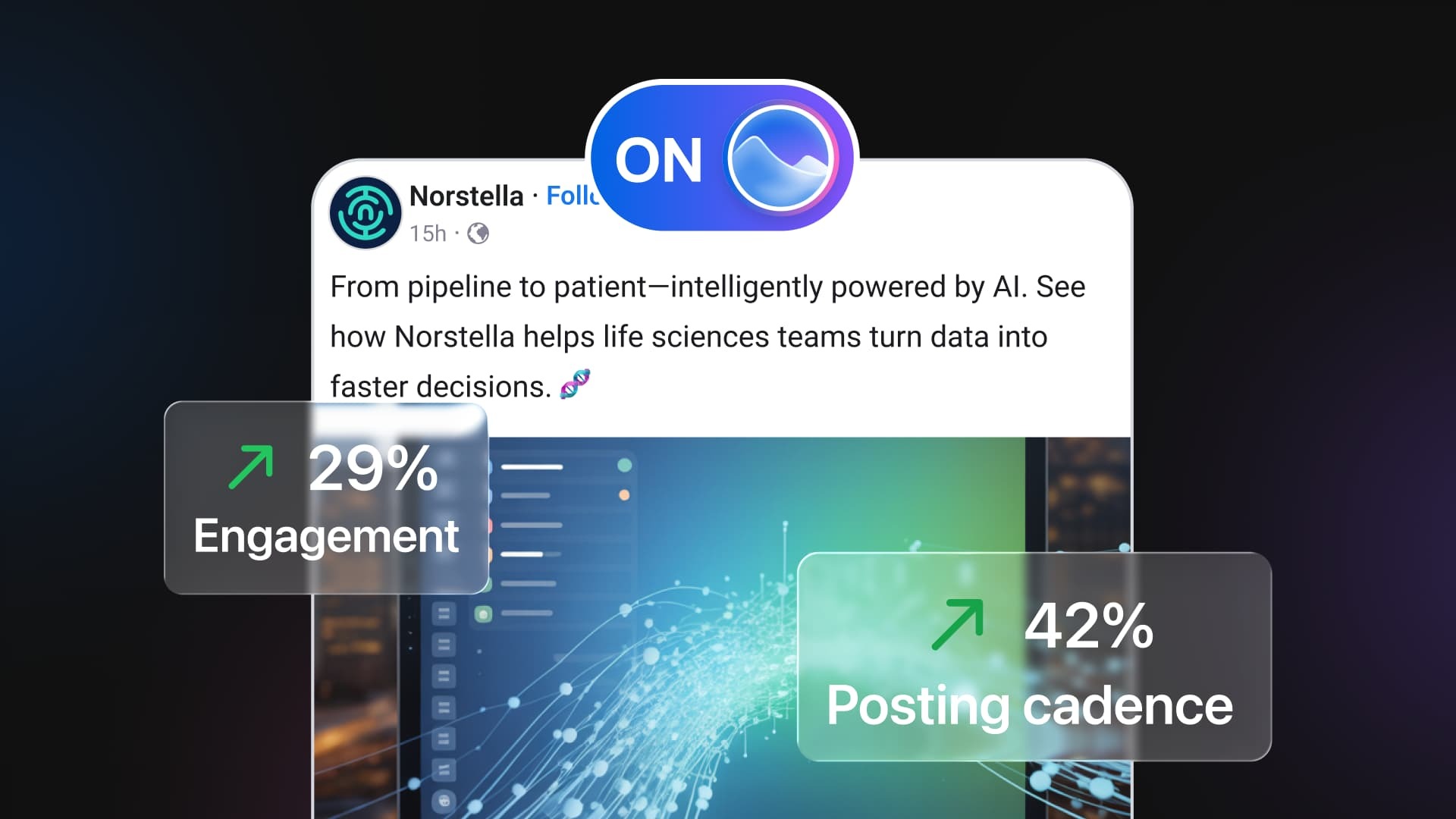
Norstella unites the industry’s most trusted pharma intelligence brands—Citeline, Evaluate, MMIT, Panalgo, Skipta, and The Dedham Group—behind one mission: getting life-saving therapies to patients faster.
Its AI engine powers smarter decisions across forecasting, clinical trial design, market access, and patient activation. Managing the social strategy for Norstella and its brands is a serious operation, run by a social team publishing for varied audiences across several platforms, countries, and time zones every day.
An operation like that doesn’t switch social media platforms on a whim. With 25 users, multiple global brands, and a legal team reviewing every security decision, changing tools is a real project with real risk attached.
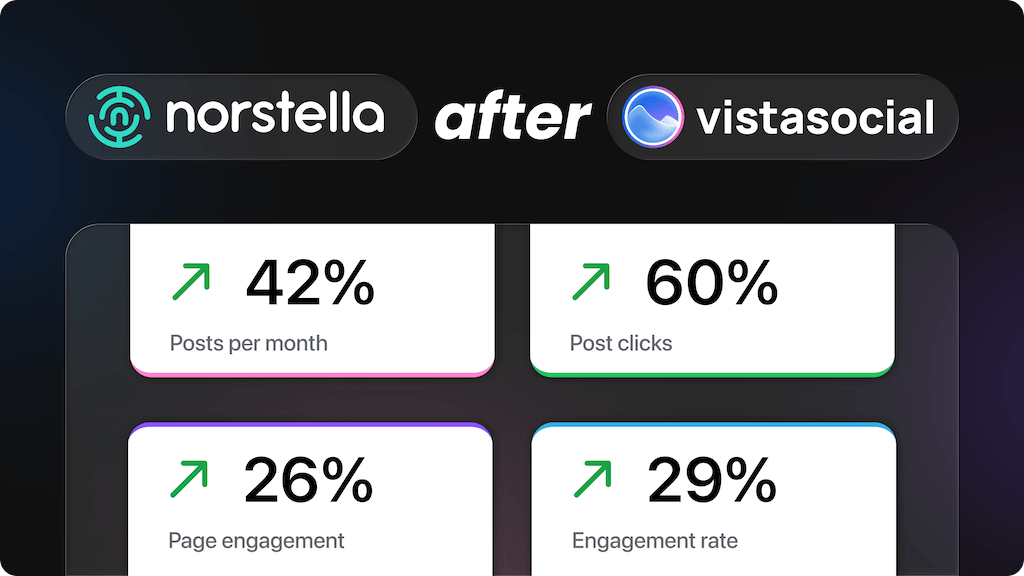
Norstella made that move to Vista Social in April 2025. Within months, its flagship brand was posting 42% more often on LinkedIn, while post clicks climbed 60%, page engagement rose 26%, and the engagement rate improved by nearly 29% year-over-year. They managed to publish more and perform better at the same time, which rarely happens when you turn up the volume.
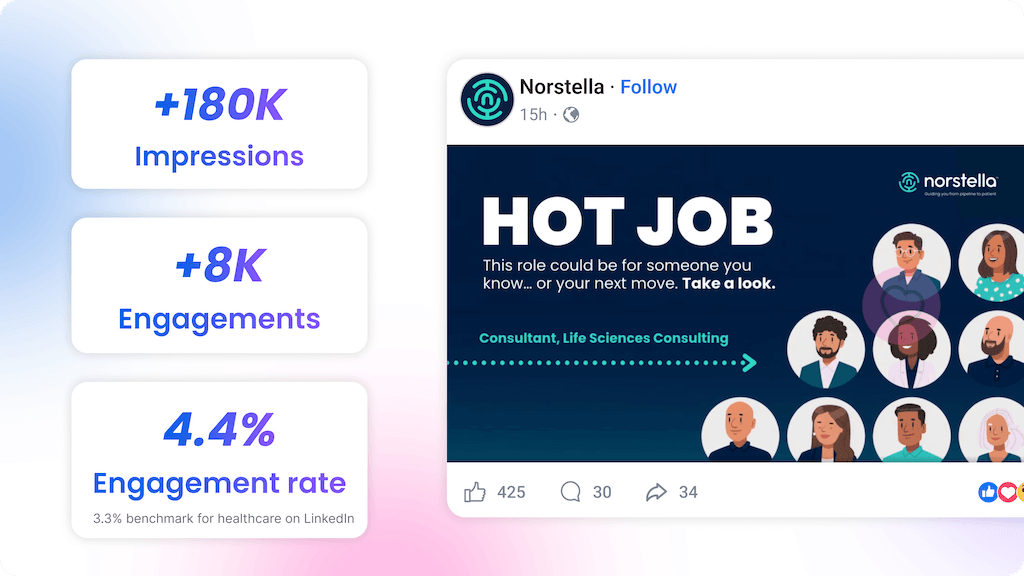
Did the reclaimed hours make the team’s day-to-day calmer? Yes, but the bigger payoff was what Norstella could do with them. The team ran more campaigns, gave stronger ideas the attention they deserved, and tested new formats. One of those experiments, Hot Job Alert, became a repeatable series with a 4.4% engagement rate, ahead of the 3.3% sector benchmark.
The problem: a global social operation stuck on a tool that stopped evolving
Before Vista Social, Norstella used a well-known social media enterprise platform. On paper, it had the credentials of a serious tool, but in daily use, it had quietly stopped keeping up.
The interface felt dated and clunky, and meaningful updates had slowed to a trickle. Brenton Marcum, Norstella’s Senior Social Media Manager, watched the product stall over the better part of two years.
“Our previous software had limited new features released over the two years we were using it. It had gone completely static, and so had our confidence in it.”
The bigger issue was friction, and at Norstella’s scale, small friction multiplies fast. The old tool only let the team set one time zone across every account at once, so to make a UK brand’s post land during standard business hours, someone had to manually convert that time into the platform’s single set time zone before scheduling, then do the same conversion again for the next post, and the next.
The bigger issue was friction, and at Norstella’s scale, small points of friction multiplied fast. The previous tool allowed the team to set only one time zone across every account, even though Norstella publishes for brands around the world.
If Brenton scheduled a post for UK-based Evaluate from Iowa, he had to convert the publishing time from Central Time by hand. A teammate posting to the Citeline Evaluate Japan brand had to run the same calculation against Tokyo time. Every cross-border post brought another manual conversion and another chance for error.
The approval process was an even heavier drag. No post goes live at Norstella without a second set of eyes, and that review runs through Monday.com. With the previous tool, that meant screenshotting individual posts and pasting them in for review. This meant that every edit required a new set of screenshots, creating a very manual and back-and-forth process.
Brenton goes on to say, “In addition, features that should have been standard felt like we were being nickel-and-dimed. For a 25-person team operating across brands and geographies, the tool had simply stopped earning its keep.”
Norstella set out to find a platform that could:
- Onboard 25 users across six brands without a steep learning curve
- Set time zones per brand to end manual conversion errors
- Replace screenshot approvals with a real review workflow
- Keep evolving, with a vendor that ships and listens
A 45-minute reply that changed their mind
Brenton first came across Vista Social at Social Media Marketing World in 2025. He’d tested the software before and had one feature request, which he mentioned to the Vista Social founder in person at the conference.
Forty-five minutes later, an email landed in his inbox letting him know the feature was already in progress.
That single exchange told him everything he needed to know about the difference between a tool that had gone static and a tool that takes its customers seriously. Norstella moved off its previous vendor within weeks.
“Meeting the Vista Social team in person was genuinely impactful. Getting to connect with the founders and see live demos firsthand was what pushed us over the edge to make the switch, and we haven’t looked back.”
When the team sat down to evaluate properly, the criteria were strict. Ease of use came first, since onboarding two dozen people onto a new platform leaves no room for a steep learning curve. They needed a tool that was actively evolving, the ability to set time zones per brand, and built-in approval workflows that felt like a breeze.
Vista Social cleared every bar, and it did so at a meaningfully lower cost than what Norstella had been paying. It offered a stronger interface, a deeper feature set, and a better price.
What changed: the workflow Norstella runs on Vista Social today
The switch itself is the kind of project that usually keeps enterprise teams up at night, and for Norstella it went smoothly.
It’s worth being honest about why that was a real risk before saying it went well. Moving 25 users and multiple live global brands off an entrenched enterprise tool is the kind of migration that can drop scheduled posts, break account connections, or stall behind a security review for a quarter.
Every security decision ran past Norstella’s legal team. Single sign-on had to be configured and coordinated with IT before anyone could log in, and none of the brands could afford to go dark during the handover. The reason it didn’t break is the part nervous teams will want to see, so here’s how it actually ran.
Onboarding 25 users without the chaos
Brenton and his manager worked with Norstella’s legal team to make sure the setup met their security policies, with single sign-on configured for every user. The team communicated the transition via a Microsoft Teams group, keeping everyone aligned on the plan, reasoning, and timeline.
Vista Social was set up brand by brand, with all accounts connected and users invited into their respective brands. Once SSO was live and coordinated with IT, the learning curve was minimal and the team was up and running quickly.
Today, 25 people publish through the platform. The core social team sits alongside a wide range of contributors across brands, including journalists, heads of marketing, and demand generation managers who post daily without carrying a social media title.
Live approval links instead of screenshots
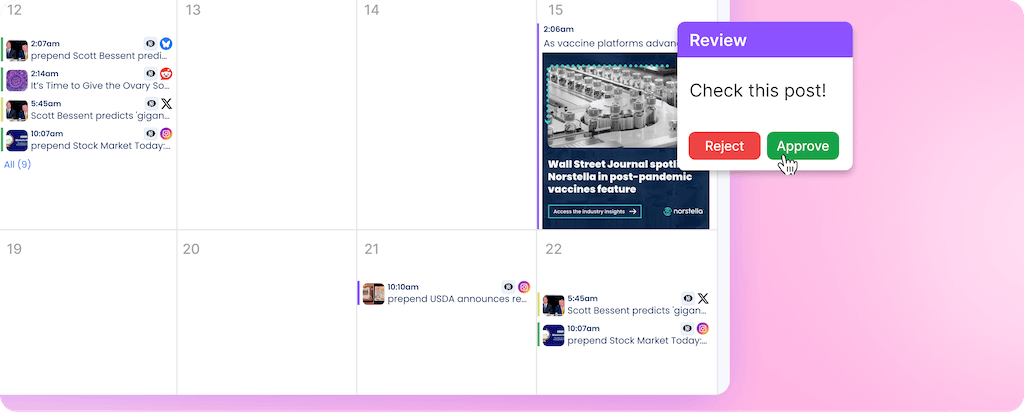
The feature Brenton calls a “revelation” is the live approval link. Instead of the manual process of screenshotting and copy-pasting every post without an easy way to edit them in Monday.com, the team now shares a live calendar link with any stakeholder or leader for real-time review, feedback, and sign-off.
“Live calendar links that can be shared with any stakeholder or leader changed everything. The ability for real-time review, feedback, and post-approval has made our processes more efficient and streamlined.”
Time zones by brand
Setting a time zone per brand sounds almost too basic to matter. For a global team, it removed a constant source of scheduling errors overnight.
“Time zones by brand sounds like a basic feature, but it was a genuine game-changer. No more manually calculating hours to make sure a post for a UK-based brand goes live during standard business hours.”
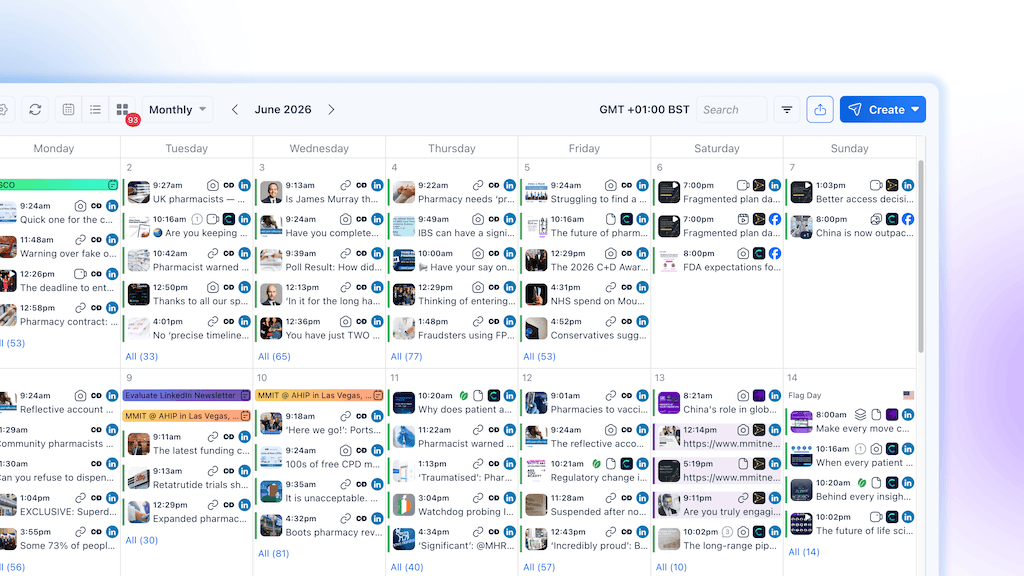
Tags, search, and filters that keep a busy calendar legible
Tags are central to how Norstella operates. Posting across multiple brands every day, the team uses tags to classify content by campaign, see what’s performing best, and make smarter decisions about what to create next.
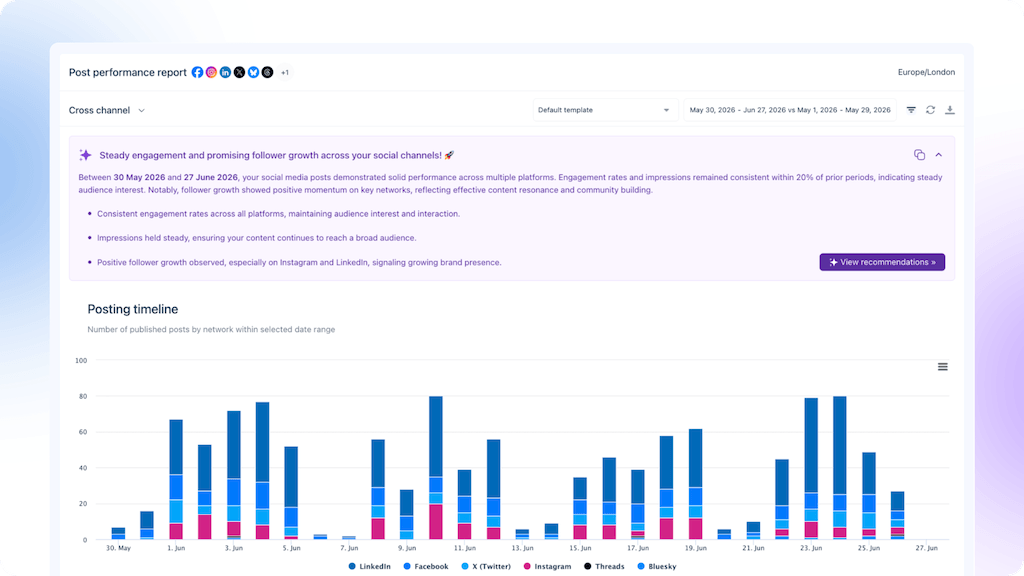
The search bar surfaces specific posts in a crowded calendar in seconds, and filters let Brenton see, for instance, exactly how many product and solution posts are scheduled for the month. It’s the kind of visibility that keeps a high-volume operation from running on guesswork, and the team’s performance reporting feeds straight back to leadership from the same place.
Evergreen for content worth repeating
For content that isn’t tied to a specific date, like thought leadership, case studies, and whitepapers, Norstella leans on the Evergreen feature to keep priority pieces in rotation through the quarter without extra lift.
“I’m not aware of any competitor that has something this well-built for repurposing content.”
It fits how the team thinks about content repurposing in general: remix, repost, and get more mileage out of what already resonates. Together, evergreen repurposing, the ability to schedule a post for multiple dates in one window, and live-link approvals save the team hours every week.
A clean trail from request to live post
Norstella runs its digital marketing team on Monday.com, where every organic social request arrives by form with full context: the campaign, the brand, the creative direction, and the publish date. From there, it moves into Vista Social for scheduling.
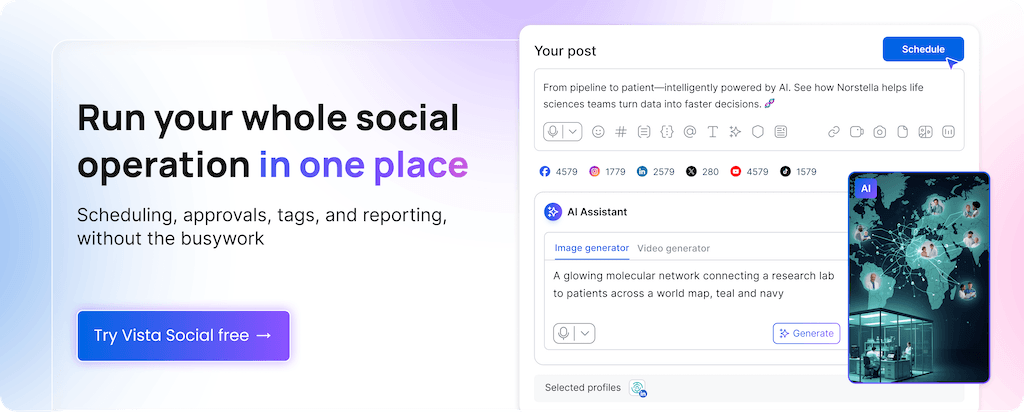
That hand-off gives the team a clean trail from the first ask to a published post, with nothing slipping through the cracks like what can happen with email threads. Vista Social’s built-in AI features have taken further time off drafting and repurposing along the way.
The results: more posts, better performance, and hours back every month
The numbers are where the switch makes its case.
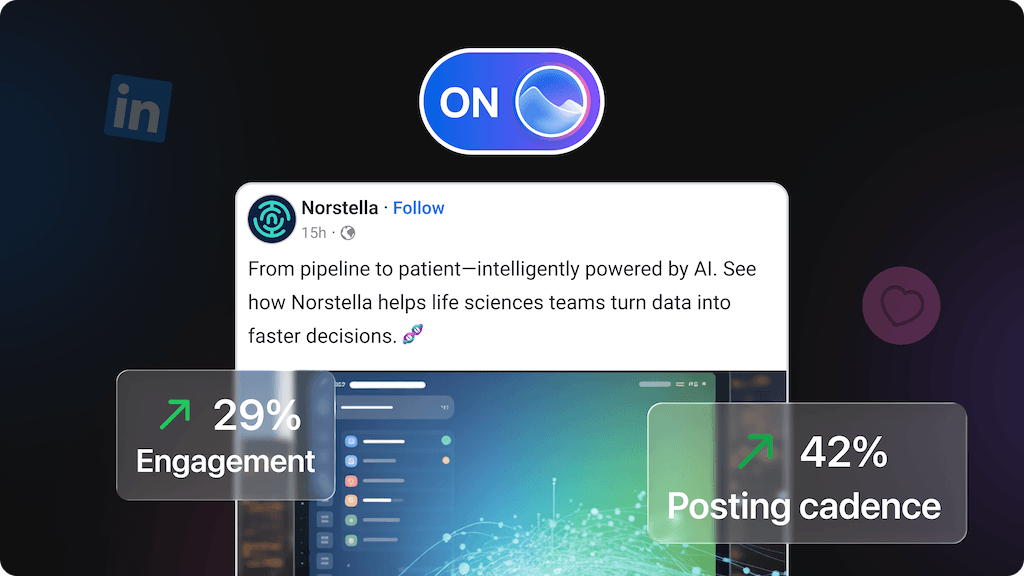
Since moving to Vista Social in April 2025, Norstella’s flagship brand increased its monthly LinkedIn posting cadence by 42%, a pace it has sustained into 2026. Output going up is one thing, but what stands out is that performance climbed right alongside it.
Over the same period, page engagements rose 26%, post clicks jumped 60%, and engagement rate improved by nearly 29% year over year. More volume usually dilutes engagement, but Norstella increased both at once, which points to a team that finally had the time and tooling to focus on the work instead of the workflow.
The Hot Job Alert campaign
The clearest proof sits in a campaign called Hot Job Alert. About a year ago, the social media team stopped publishing generic “we’re hiring” posts and instead partnered with the talent team to spotlight specific open roles.
Since May 2025, those posts have run consistently on LinkedIn with results that beat the benchmark for their sector. The series has pulled in 181,000 impressions, 8,000 engagements, and a 4.4% engagement rate, comfortably above the roughly 3.3% average for healthcare, pharma, and biotech on LinkedIn.
Then the design team got involved, and the creative evolved from static branded graphics into short animated videos that took off. Norstella’s top three Hot Job Alert posts by engagement are all animated, including one that hit a 10.7% engagement rate and drew real comments from people genuinely interested in the role.
Running the whole campaign through one platform, from scheduling to publishing to tracking, is what made it repeatable. An experiment turned into one of Norstella’s most consistent content series on LinkedIn. Turning a content idea into a hiring channel.
The verdict: a switch they wish they’d made sooner
Switching social platforms at enterprise scale, with posters across multiple countries and brands, is not a decision anyone makes lightly. There has to be a compelling reason, and for Norstella the reason held up.
“The difference from our previous vendor has been night and day, and we’re glad we made the move. It’s almost dizzying keeping up with everything Vista ships, in the best way possible. We appreciate that our feedback is heard and that the tool keeps getting better and better.”
Brenton’s advice to any team weighing the same decision is refreshingly simple: “Commit to the free trial and use it as if it were your only tool. That’s the best way to see the real workflow gains.”
For a serious social operation that has outgrown a tool which stopped growing with it, that trial is the easiest way to see exactly what changes.